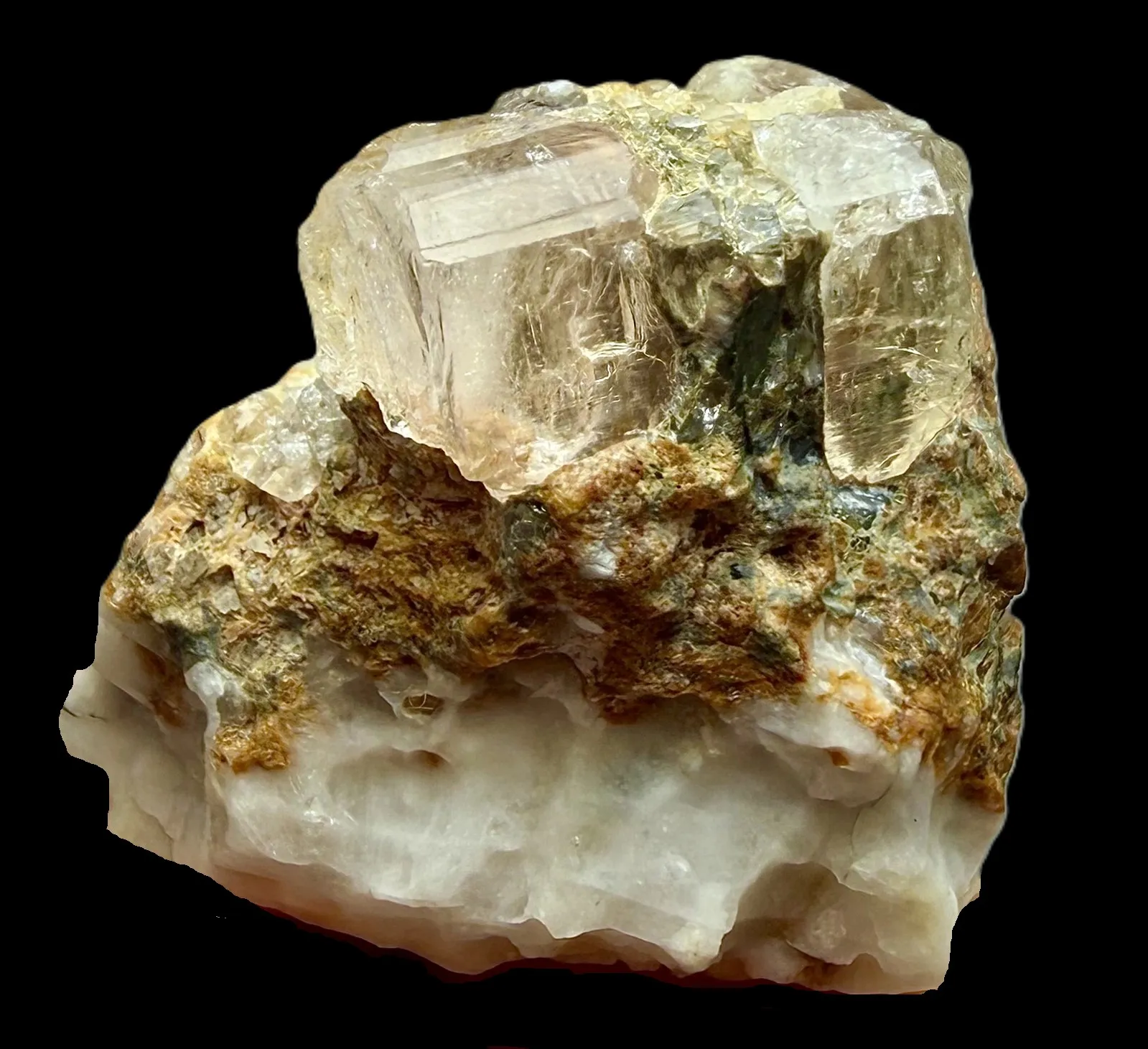
Idiomorphic Topaz Crystals on Pegmatitic Matrix – Locality: Katlang, Mardan, Pakistan
The Formation of Topaz Crystals on a Pegmatitic Matrix
This mineral specimen documents the formation of topaz crystals during the late evolutionary stage of a granitic pegmatite. A pegmatite is an igneous rock that forms from a highly differentiated, silica-rich residual melt derived from a magma body and is often characterized by exceptionally large crystals as well as the occurrence of rare minerals.
The particular significance of this specimen lies in the clearly recognizable relationship between the already established matrix and the topaz crystals that subsequently grew upon it. The spatial arrangement of the minerals allows conclusions to be drawn about the chronological sequence of mineral formation and illustrates a typical process of late-stage magmatic crystallization within a highly evolved pegmatitic system.
Microscopic examination of topaz crystals on a pegmatitic matrix.
Formation of the Pegmatitic Matrix
The matrix forms the foundation of the specimen and consists predominantly of quartz and feldspar, the most common rock-forming minerals in granitic systems. These minerals crystallized during an earlier stage of pegmatite formation directly from the silica-rich melt and established the structural framework of the rock.
During progressive cooling and crystallization, the composition of the remaining residual melt changed continuously. Certain elements that are only incorporated to a limited extent into the early-forming minerals became increasingly concentrated. These include fluorine as well as other volatile components such as water. The enrichment of these components enhanced the mobility of dissolved elements and created the conditions necessary for the formation of specialized late-stage minerals.
Crystallization of the Topaz Phase
Topaz (Al₂SiO₄(F,OH)₂) is a characteristic mineral of highly evolved, fluorine-rich pegmatite systems. Its formation requires a sufficient supply of aluminium, silicon, and particularly fluorine. These components were transported and concentrated within the late residual melts and associated fluid phases generated during the final stages of pegmatite evolution.
Once the matrix minerals had largely developed, topaz began to crystallize upon their surfaces. The existing mineral surfaces provided favourable sites for nucleation and subsequent crystal growth. Due to the availability of open growth space, the crystals were able to develop without significant restriction and attain their characteristic morphology.
The topaz crystals exhibit an idiomorphic habit. This term describes crystals that preserve their own characteristic external form, with well-developed crystal faces, because their growth was not significantly constrained by neighbouring minerals. The sharp edges and planar crystal faces therefore indicate slow and largely undisturbed growth under stable physicochemical conditions.
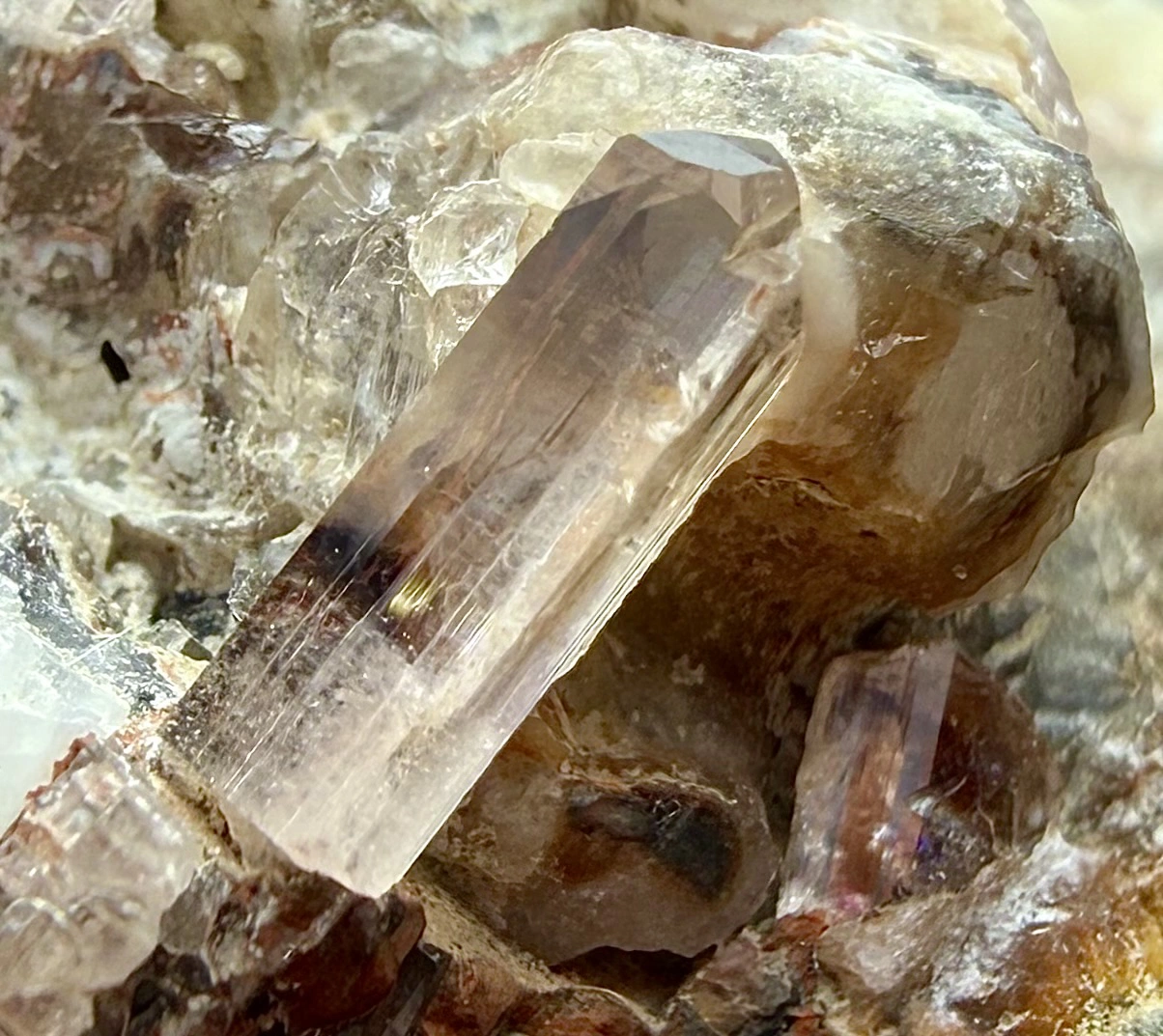
Detailed view of a sharp, prismatic Topaz crystal on matrix – Locality: Katlang, Mardan, Pakistan
Sequence of Mineral Formation
The formation of this mineral specimen can be divided into three successive developmental stages:
Phase I – Formation of the Matrix:
During the early cooling stage of the pegmatitic system, quartz and feldspar crystallized first and formed the fundamental framework of the specimen.
Phase II – Geochemical Differentiation:
As crystallization progressed, the remaining residual melt became increasingly enriched in fluorine and other incompatible elements. This chemical evolution produced a highly specialized residual phase from which rare late-stage minerals could form.
Phase III – Growth of Topaz:
During the final stage of mineralization, topaz crystallized upon the pre-existing matrix surfaces. The slow deposition of dissolved components allowed the development of well-formed crystals with their characteristic prismatic habit.
The Mineral Specimen as a Record of Geological Processes
The paragenesis, meaning the chronological sequence of mineral formation within a rock, reveals a distinct evolutionary history in this specimen: the quartz–feldspar matrix represents the earlier stage of pegmatite crystallization, whereas the topaz records a later phase of advanced chemical differentiation.
Mineral specimens of this type are therefore significant not only for their aesthetic qualities but also because they preserve information about the geological processes that occurred during the final stages of pegmatite evolution. The combination of a pre-existing mineral matrix and subsequently grown topaz crystals provides direct evidence of how specialized minerals can develop step by step from a chemically evolved residual melt.
The formation of idiomorphic topaz crystals upon an already established matrix represents a remarkable example of the complex evolution of highly differentiated pegmatitic systems. Such specimens preserve a sequence of crystallization events and provide a direct insight into the physical and chemical conditions under which rare minerals form during the final stages of magmatic evolution.
Another specimen from Katlang featuring a fine Topaz crystal – Katlang, Mardan, Pakistan