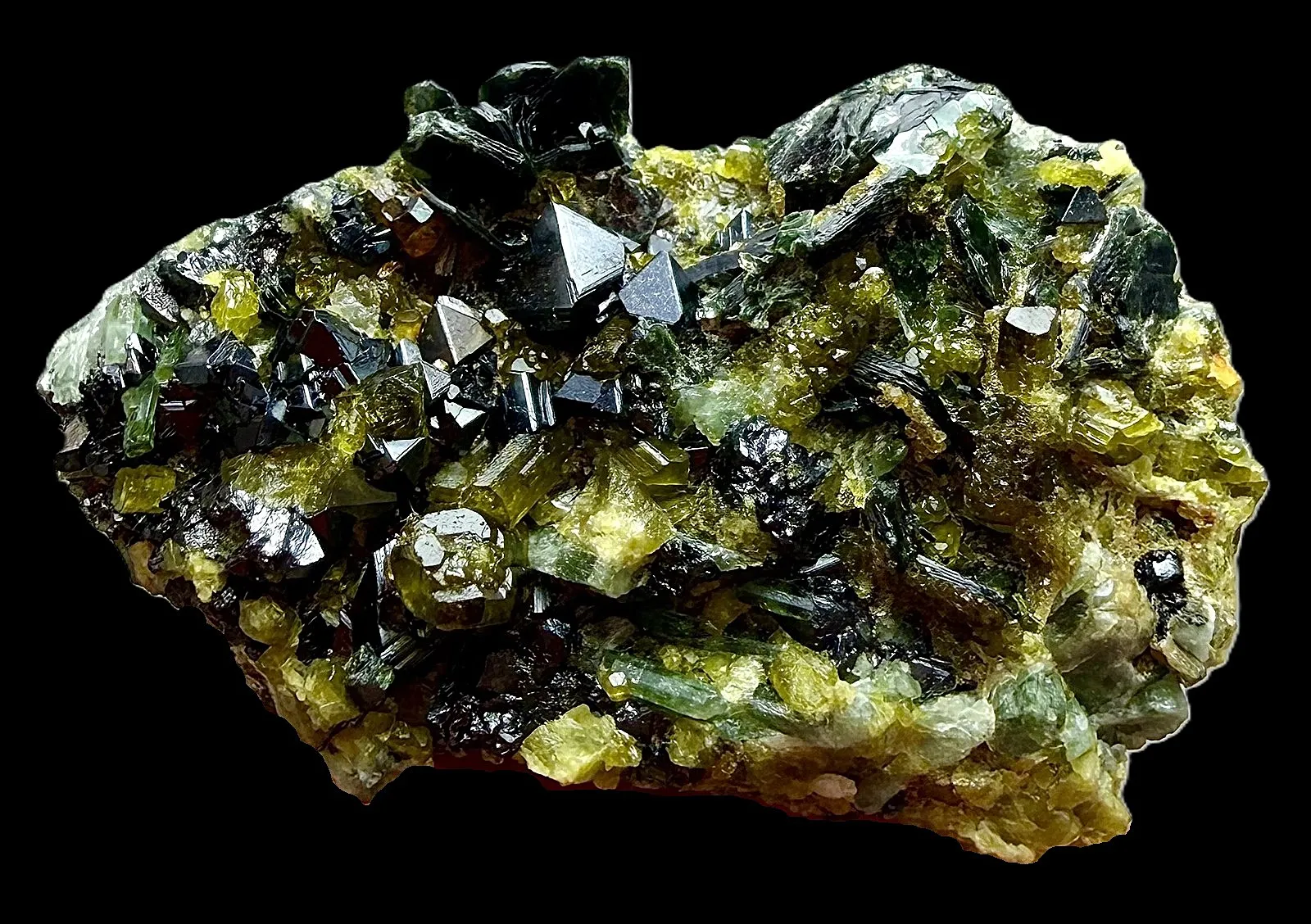
This specimen from Afghanistan displays a complex mineral paragenesis characterized by hydrothermal overprinting and successive crystallization processes within a volcanic-metasomatic environment. The specimen is defined by a distinct morphological differentiation between the silicate matrix and the late-stage, overgrowing oxide crystals.
Mineralogical Composition and Matrix Formation
The matrix is composed of a dense, subparallel to granular aggregation of vesuvianite (idocrase) and diopside.
Vesuvianite (Ca₁₀(Mg,Fe)₂Al₄(SiO₄)₅(Si₂O₇)₂(OH)₄): This complex sorosilicate dominates the fabric, exhibiting a yellowish-green to olive-green coloration. The crystals show a vitreous luster and occur in partially prismatic habits. Vesuvianite typically forms in contact-metasomatic zones (skarns), where calcium-rich rocks are infiltrated by silica-rich hydrothermal fluids.
Diopside (CaMgSi₂O₆): As a member of the pyroxene group, diopside forms intimately intergrown, acicular to columnar aggregates. Its crystalline intergrowth with vesuvianite indicates simultaneous growth during the initial phase of hydrothermal infiltration, characterized by an abundance of calcium, magnesium, and silicon within the fluid system.
Crystallization of the Magnetite Phase
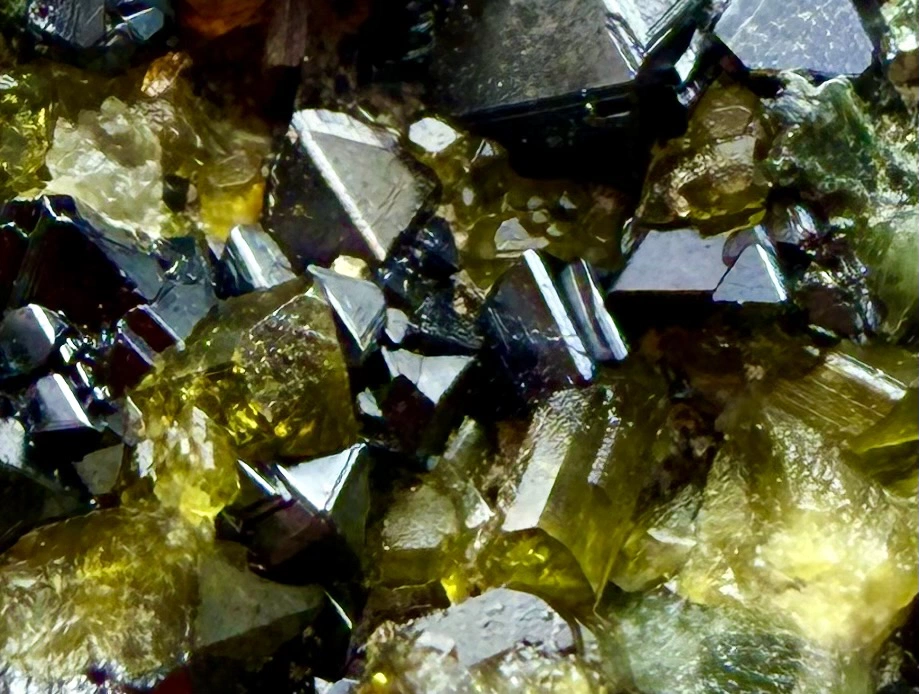
The magnetite crystals (Fe²⁺Fe³⁺₂O₄) perched on the matrix represent a significantly later stage of mineralization.
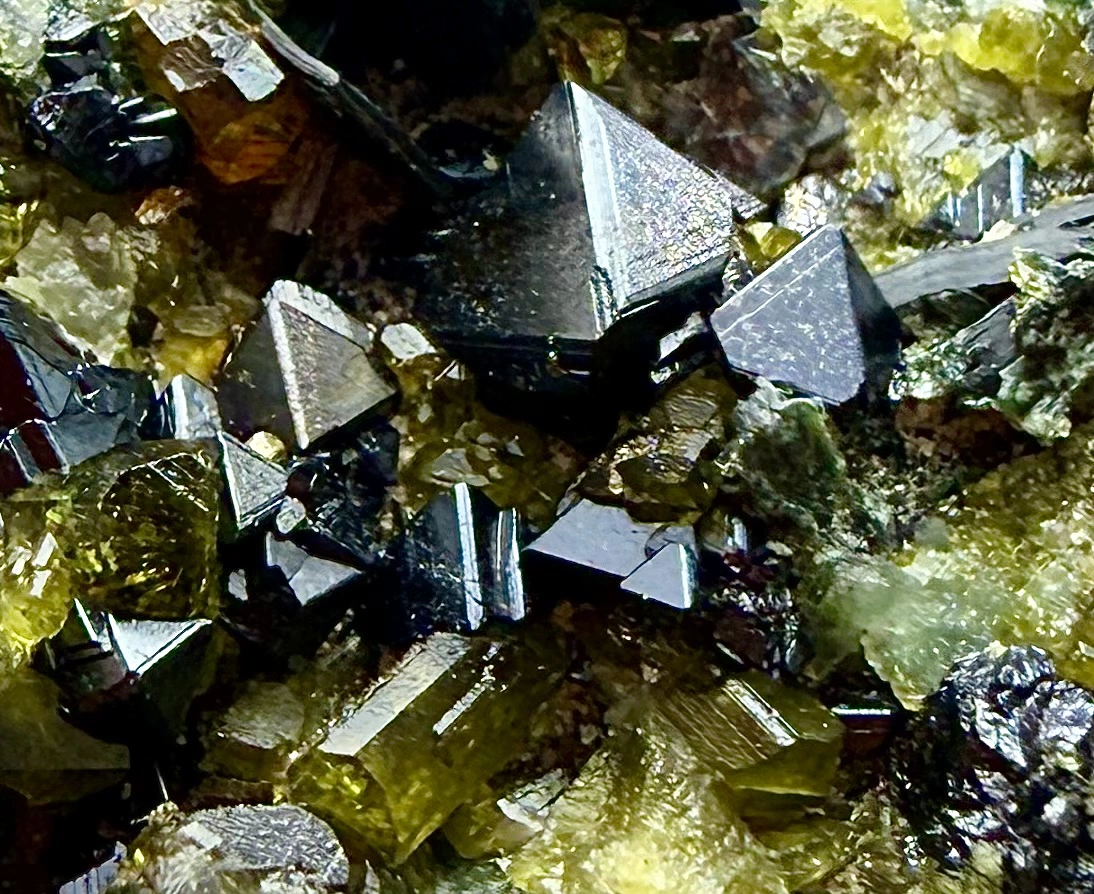
Magnetite crystallizes in the cubic system, as evidenced by the sharp-edged octahedral forms present. In contrast to the relatively massive matrix formation of the silicates, the idiomorphic (well-developed) magnetite crystals testify to an undisturbed growth within an open cavity.
This process can be interpreted as follows:
Phase I (Skarn Formation): Under high temperature and pressure, the calcium silicates (vesuvianite/diopside) precipitated.
Phase II (Geochemical Evolution): With decreasing temperatures or a shift in oxidation-reduction conditions (redox potential) within the hydrothermal system, the solubility of iron increased.
Phase III (Deposition): Magnetite crystallized from the remaining, iron-enriched fluid onto the pre-existing matrix surfaces. The geometric perfection of the octahedra underscores that sufficient pore space and fluid saturation were present at the time of magnetite formation.
Paragenetic Implications
The specimen documents the transition from a metasomatic silicate phase to a later, oxidic mineralization. The combination of strongly differing crystal lattice structures (complex silicates vs. cubic oxides) and the sharp demarcation of growth phases make this piece a typical example of local hydrothermal mineralization events, as found in the geologically active regions of Afghanistan. The spatial arrangement of the crystals allows for a reconstruction of the chronological sequence of fluid-rock interaction within a specific cavity.