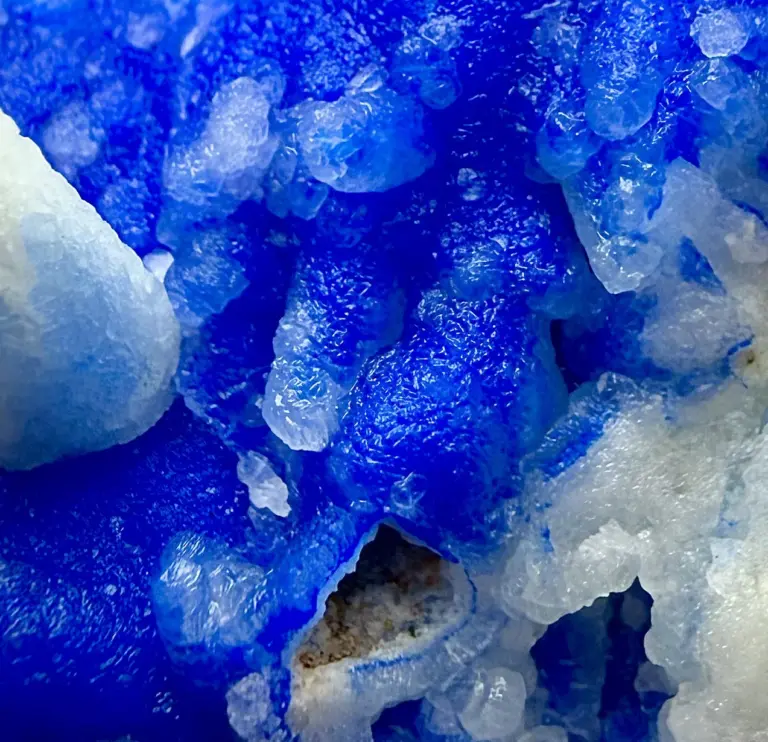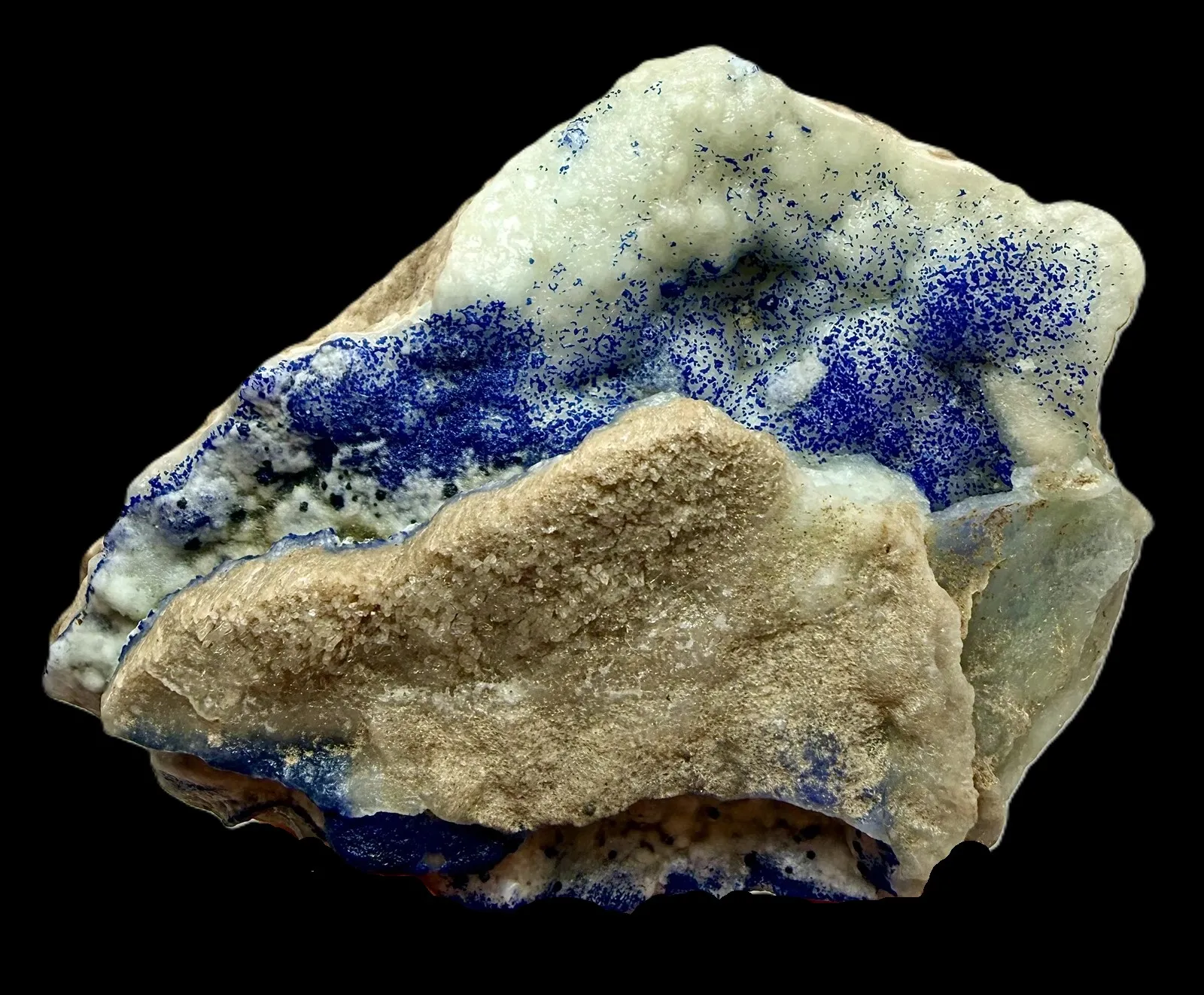
Azurite on Aragonite: Geochemical Mineral Genesis
This specimen serves as evidence of the complex alteration processes within an oxidation zone. This zone describes the near-surface area of an ore deposit where primary sulfide ores are chemically decomposed by the influence of meteoric waters, oxygen, and carbon dioxide. During this weathering process, metals—specifically copper—are leached into solution and migrate through rock fractures and pore spaces. As these copper-rich fluids encounter carbonate environments, a geochemical exchange occurs, initiating the precipitation of new mineral phases.
The Dynamics of the Oxidation Zone
The formation of this mineral is based on a precise chain of geochemical reactions. Initially, copper ions released by the decomposition of sulfide ores migrate into deeper zones via percolating water. The mobility of these ions ceases once chemical conditions—primarily pH levels and the concentration of dissolved substances—change decisively at the interface with the host rock. The aragonite matrix acts as a reactive barrier, inducing the precipitation of the copper carbonate azurite ($Cu_3(CO_3)_2(OH)_2$) through its chemical composition.
Mineralogical Concepts of Formation
The observed structures can be defined through fundamental mineralogical concepts:
-
Paragenesis: This term denotes an association of minerals that formed under the same or sequential physicochemical conditions within the same geological setting. The aragonite matrix represents the primary phase, upon which the azurite deposited during subsequent hydrothermal alteration or meteoric circulation. Both minerals document the consecutive stages of a chemical process at a specific site.
-
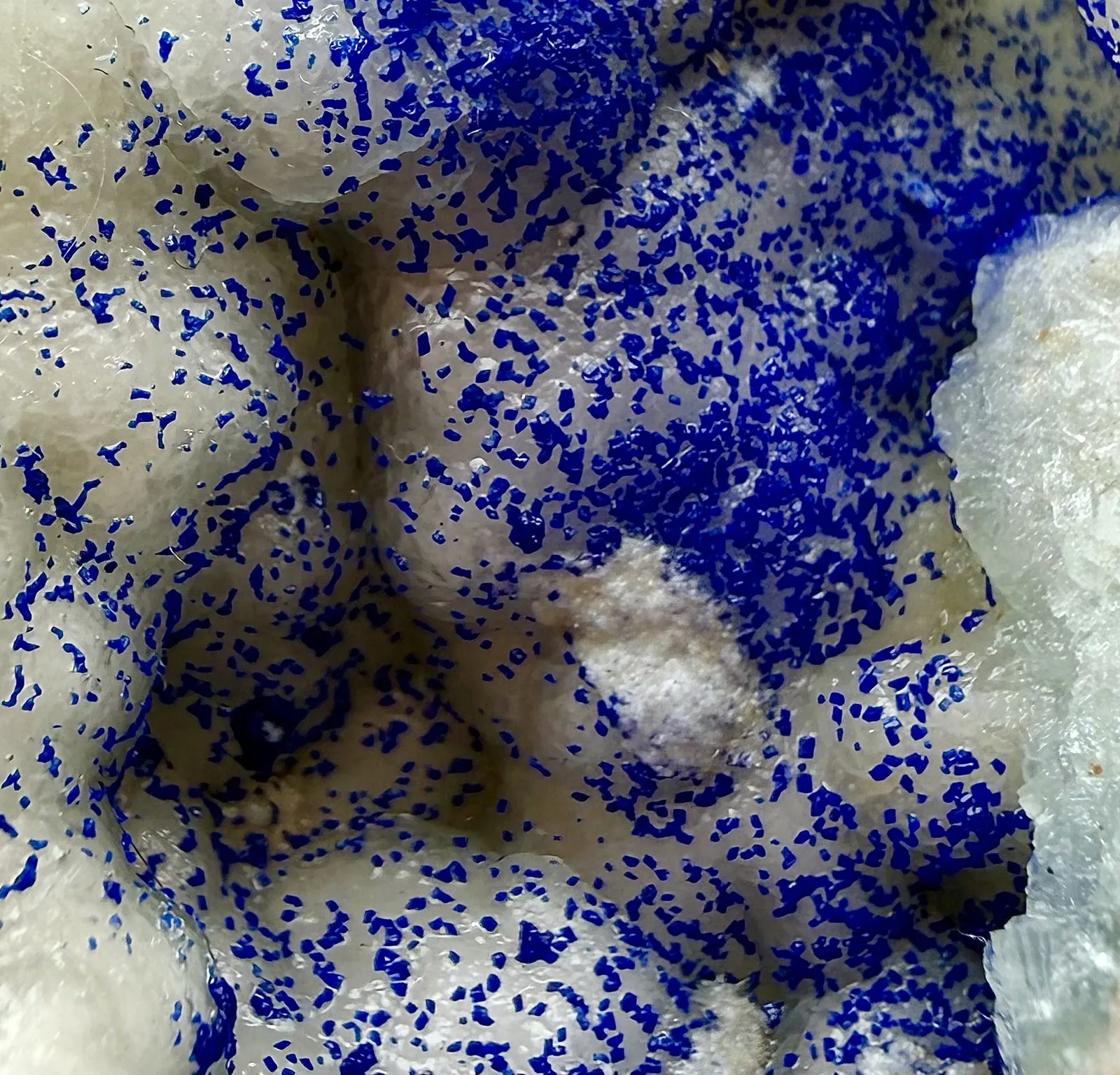
Crystal Habit and Nucleation: Crystal habit refers to the external form in which a mineral crystallizes. Azurite exhibits a fine-crystalline expression in the form of discrete, point-like aggregates. These “dots” are the result of a specific nucleation process. Crystallization did not begin through uniform surface coverage but rather at discrete, energetically favorable nucleation centers on the aragonite surface. This indicates that the geometry of the matrix and local chemical gradients significantly steered the spatial distribution of the crystals.
-
Precipitation Genesis: The process of precipitation is a direct result of supersaturation. When copper-bearing meteoric waters encounter a carbonate substrate, local neutralization of the solution occurs. The resulting change in the solubility of the contained components forces the copper to precipitate in solid form. Each blue aggregate on the surface marks the point at which the solution’s thermodynamic equilibrium was surpassed, resulting in the fixation of the material in a precise crystalline deposit.
The topographic character of the aragonite surface, with its knobby elevations, increased the available reactive surface area and consequently influenced the distribution of the azurite aggregates. In this manner, the specimen does not merely document the presence of the minerals; it functions as an archive of a geochemical event in which the dynamics of the Earth’s crust were fixed in crystalline form.
Azurite – Mineralogical Overview
Azurite is a basic copper carbonate with the chemical formula Cu₃(CO₃)₂(OH)₂. It therefore consists mainly of copper, carbon, oxygen, and hydrogen. Azurite crystallizes in the monoclinic crystal system and commonly forms prismatic or tabular crystals, as well as rounded to botryoidal aggregates.
Azurite forms predominantly as a secondary mineral in the oxidation zones of copper-bearing deposits. There, copper released from primary copper minerals reacts with carbonate-bearing solutions. Under suitable chemical conditions, azurite precipitates from these solutions. Typical associated minerals include malachite, cuprite, chrysocolla, and various iron oxides and hydroxides.
Its characteristic deep blue to azure-blue color results from the electronic structure of divalent copper (Cu²⁺). The copper ions are coordinated by oxygen atoms within the crystal structure, producing characteristic electronic transitions that absorb specific wavelengths of visible light and give azurite its intense blue color.
Azurite has a relatively low Mohs hardness of about 3.5–4 and a density of approximately 3.7–3.9 g/cm³. It generally has a vitreous to somewhat dull luster and produces a light blue streak. When heated, azurite initially loses structurally bound water and can subsequently decompose, releasing carbon dioxide and forming copper oxides.
Azurite is closely related to malachite (Cu₂CO₃(OH)₂). Both minerals may occur together within the same deposit and can transform into one another under changing chemical conditions. Malachite is the more stable phase under many near-surface conditions, so azurite may gradually be replaced by malachite during weathering and alteration.
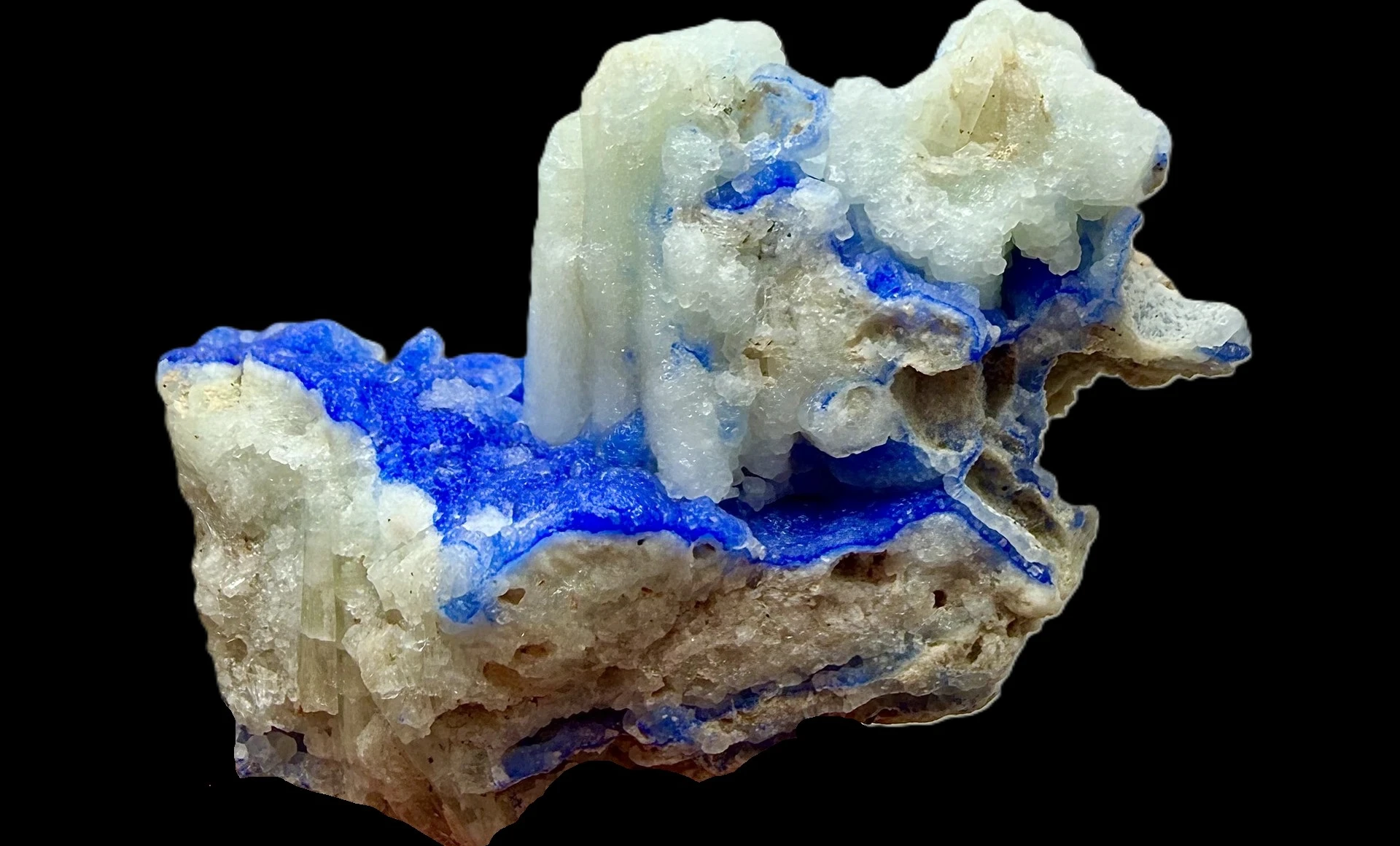
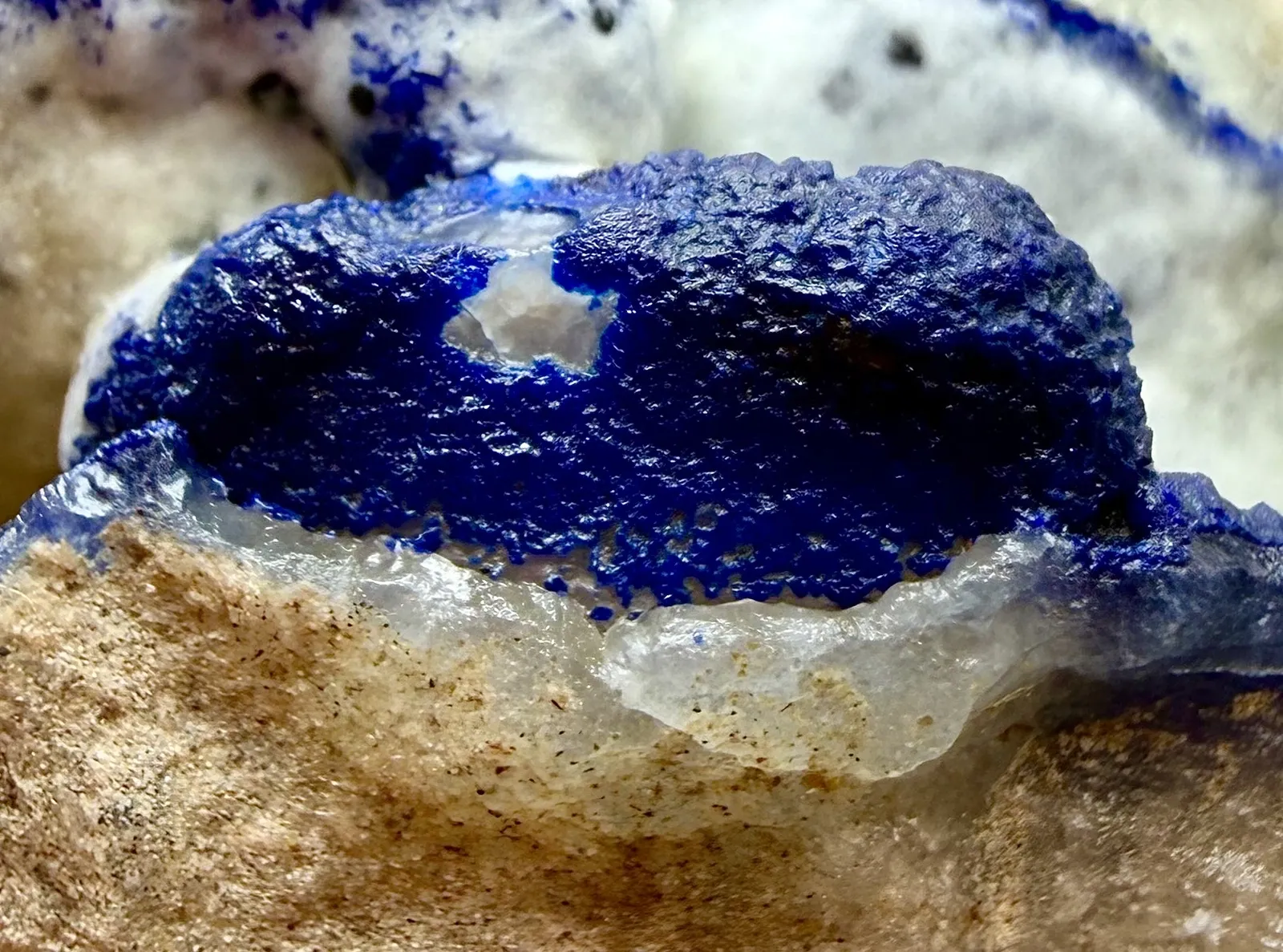
40 g Azurite–Aragonite intergrowth from Afghanistan, showing the characteristic deep blue azurite associated with white aragonite.
Aragonite – Mineralogical Overview
Aragonite is a calcium carbonate with the chemical formula CaCO₃. It therefore has the same chemical composition as calcite but crystallizes in a different crystal structure. Aragonite belongs to the orthorhombic crystal system and is consequently a polymorph of calcium carbonate.
Aragonite forms in a variety of environments, including hydrothermal and sedimentary systems, caves, and biologically produced structures. It can precipitate from calcium- and carbonate-rich solutions and is also used by numerous marine organisms as a structural component of shells and skeletons.
Characteristic forms include prismatic, needle-like, or columnar crystals, although radial, spherical, and branching aggregates are also common. Aragonite is usually colorless, white, or gray, but impurities can produce yellow, reddish, greenish, or bluish colors.
Aragonite has a Mohs hardness of approximately 3.5–4 and a density of around 2.9–3.0 g/cm³. It generally exhibits a vitreous luster and has good cleavage. Like other carbonate minerals, aragonite reacts with dilute acids, producing carbon dioxide.
Of particular mineralogical interest is the relationship between aragonite and calcite: both consist of CaCO₃, but their atoms are arranged in different crystal structures. Aragonite is thermodynamically less stable than calcite under normal surface conditions and can therefore transform into calcite over geological timescales. This structural transformation is an example of polymorphism and is important for understanding the formation and alteration of calcium carbonate-bearing materials.