Formation of an Amygdaloidal Structure
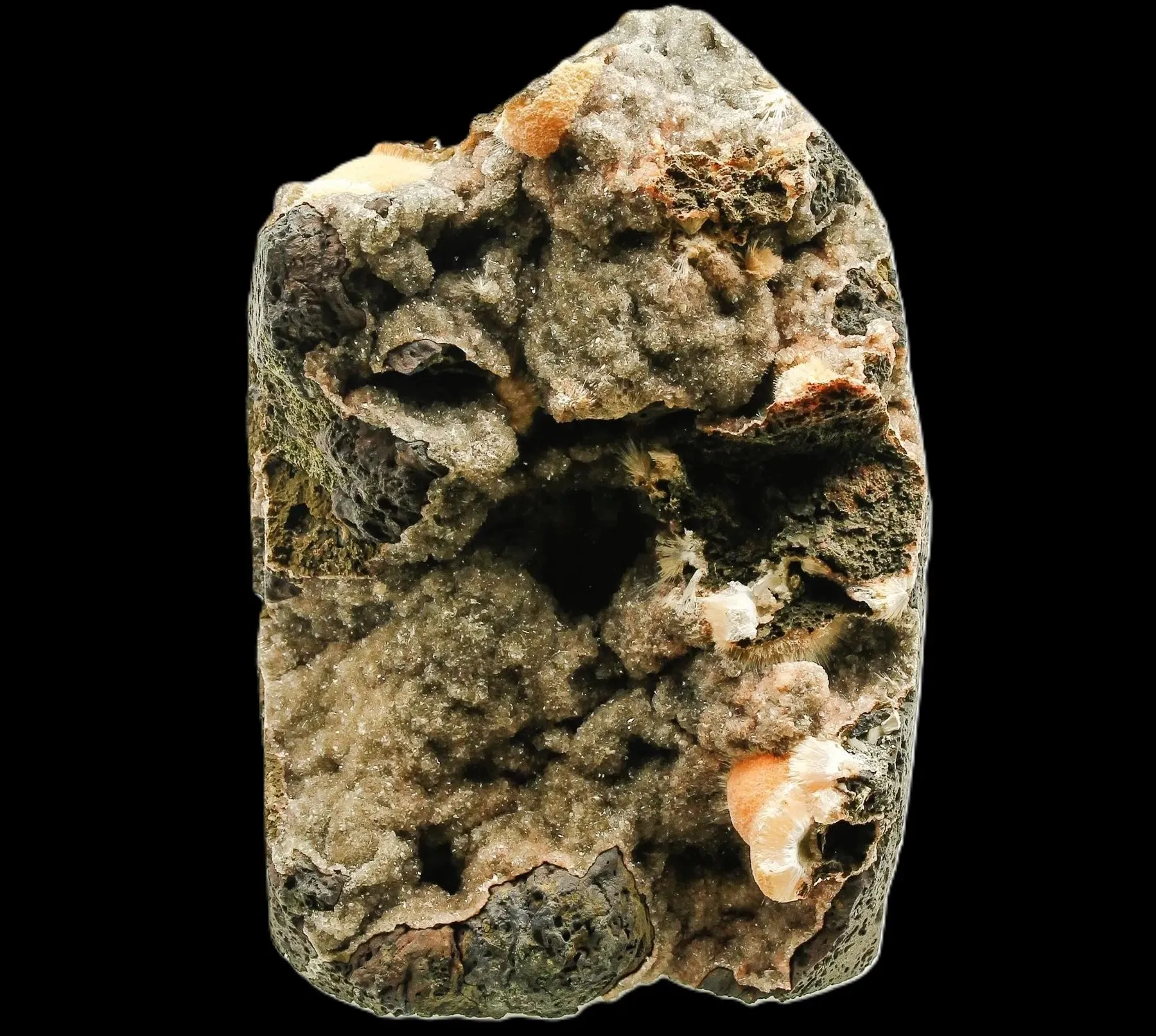
The specimen illustrates how volcanic activity can create complex mineral structures. The volcanic host rock contains cavities formed by gases trapped during lava solidification. Later, hydrothermal fluids circulated through these cavities and deposited minerals under suitable conditions. Such rocks occur worldwide in volcanic regions with extensive basalt deposits, including the Deccan Traps, Iceland, and the Keweenaw Peninsula.
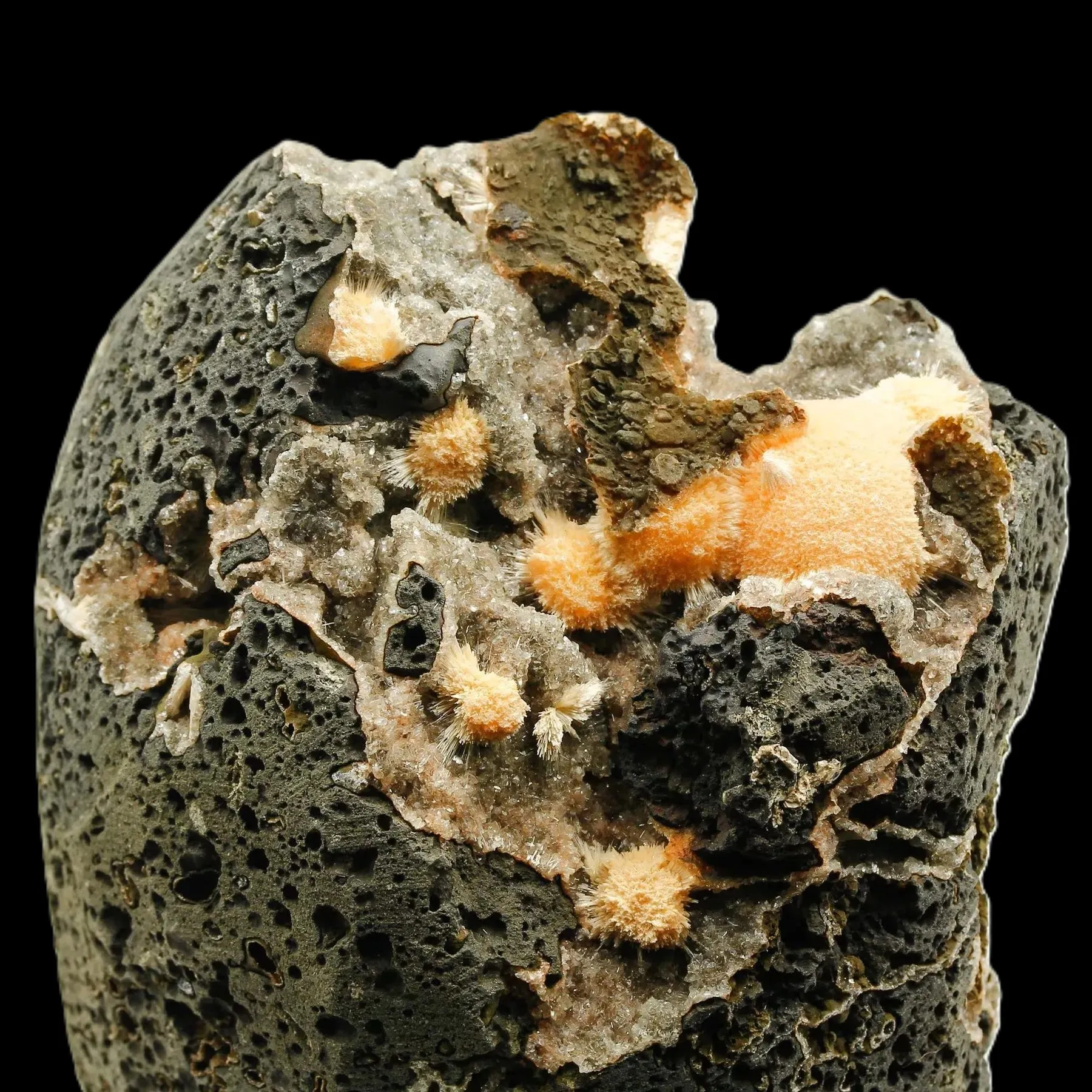
The Fiery Origin
Due to their low viscosity, basaltic lavas allow the formation of gas bubbles from dissolved volatile components, primarily water vapor, carbon dioxide, and sulfur-bearing gases, as pressure decreases at the Earth’s surface. During cooling and solidification, these bubbles become trapped in the rock and, after crystallization, leave behind cavities known as vesicles.
The size, shape, and distribution of vesicles reflect the lava’s degassing, flow conditions, and cooling history. Due to buoyancy, gas bubbles can rise within the flow and concentrate in specific zones, influencing the rock’s internal texture. These cavities later provide space for secondary mineral precipitation from circulating fluids, forming the mineral assemblages observed in the specimen today.
Hydrothermal Mineralization
After complete solidification of the host rock, hydrothermal mineralization begins. Hot, mineral-rich fluids infiltrate the basalt along fractures and void networks. Changes in temperature, pressure, and chemical conditions cause supersaturation of dissolved components, leading to mineral precipitation on vesicle walls. This process strongly depends on local P–T–X conditions and elemental availability, resulting in variable mineral assemblages even within a single lava flow. Over time, the cavities are lined and gradually filled, transforming gas bubbles into complex amygdales.
Thomsonite
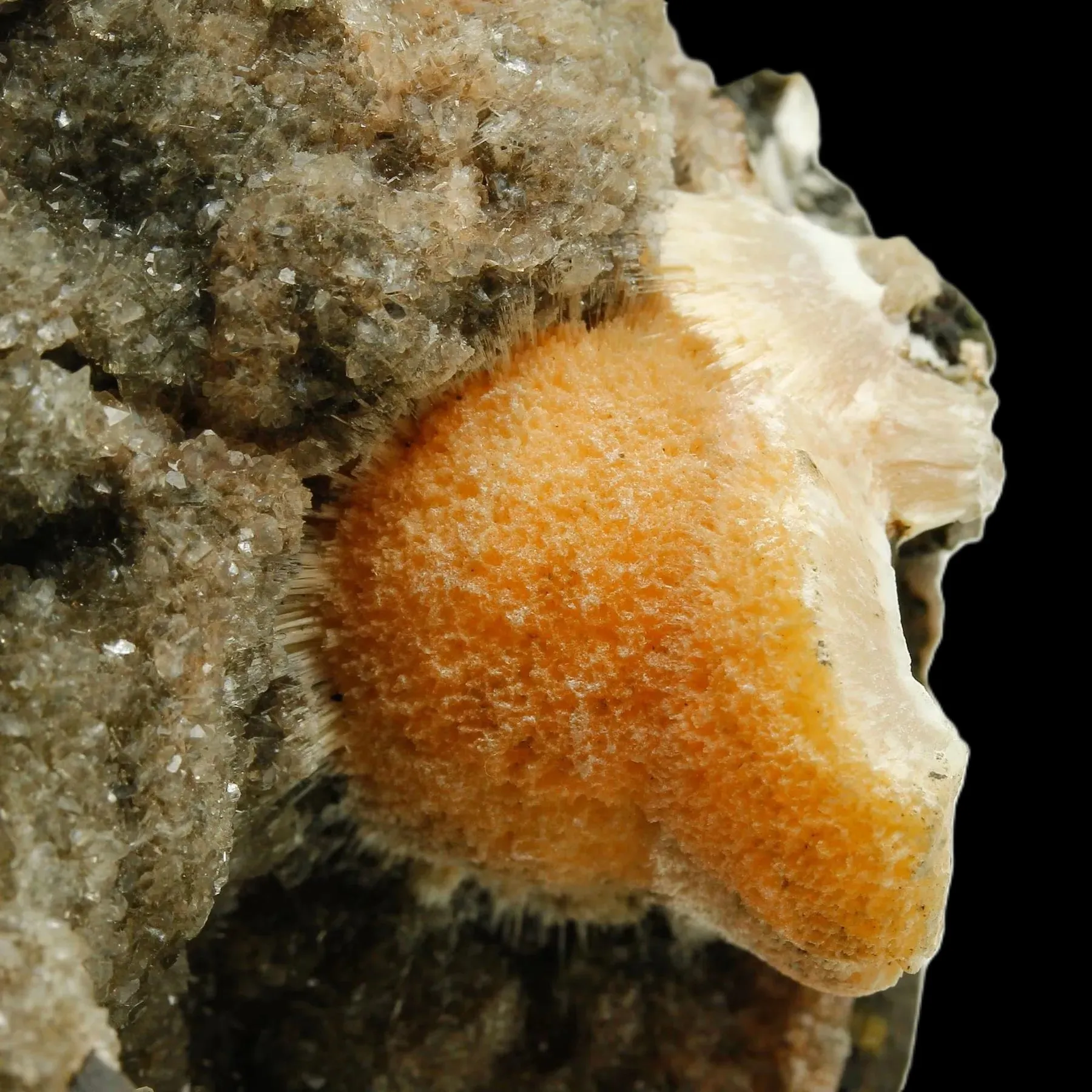
Thomsonite is a characteristic member of the zeolite group and a common phase in amygdales. As a hydrous calcium-sodium aluminosilicate, it forms fine-crystalline, often tufted to spherical aggregates. Its formation is linked to late-stage hydrothermal alteration and depends heavily on the local availability of calcium and sodium within the vesicles. In this specimen, Thomsonite manifests as distinctive, orange-to-ochre spherical aggregates that provide the primary appearance within the cavity.
A detailed observation of the cavity filling reveals a sequential crystallization process:
Chloritic Lining: At the beginning, the inner surface of the basaltic host rock is coated with a fine-grained, greenish-grey mineral layer. This corresponds to a coating of chlorite or similar phyllosilicates. This foundational crust formed prior to the zeolite precipitation, serving as a substrate for the subsequent growth of the Thomsonite and Mesolite aggregates, creating a clear lithological bridge between the basalt and the final mineral fill.
Thomsonite and Mesolite: The zeolites developed on this base. Emerging directly from the Thomsonite aggregates are delicate, acicular to fibrous white crystals. These are identified as Mesolite, which frequently crystallizes in direct association with Thomsonite. Its occurrence as fine, needle-like tufts piercing the Thomsonite spheres indicates a subtle shift in the fluid’s chemical composition or in the crystallization conditions during the final stages of growth.
Vesicle Morphology: The interaction between these mineral phases and the vesicle wall is clearly visible. Thomsonite and Mesolite do not merely coat the surface; they originate from discrete nucleation points on the chloritic layer. This demonstrates how the uneven topography of the vesicle wall significantly influenced the spatial distribution and growth patterns of the individual mineral clusters.
The specimen thus serves as a micro-archive of a cooling volcanic system: starting with the chloritic alteration of the host rock, followed by the specific geochemical conditions that favored the nucleation of Thomsonite, and concluding with the deposition of needle-like Mesolite, which completes the mineralogical succession within this specific amygdale.