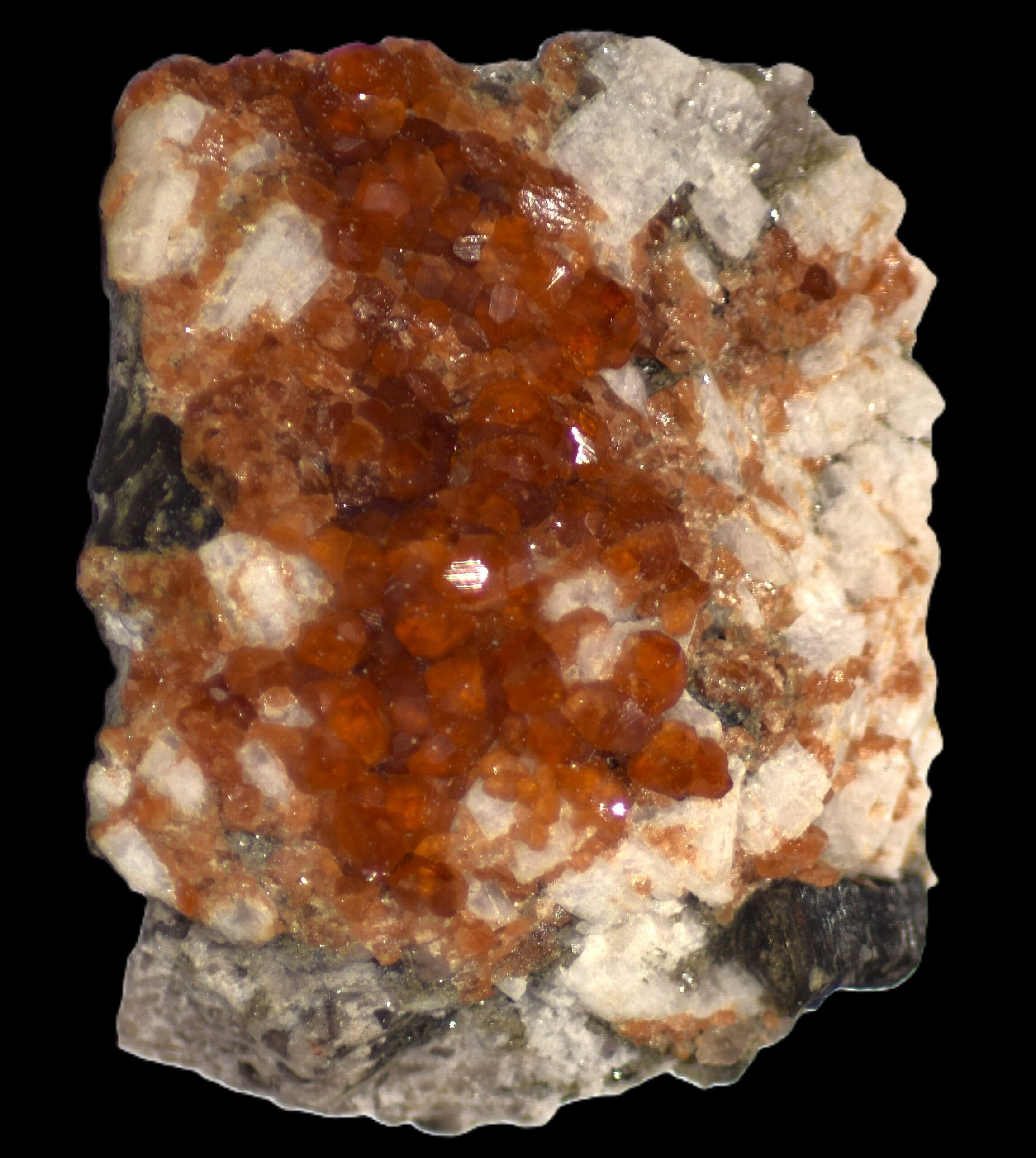
50 g spessartine garnet specimen from Wushan, China
This mineral specimen from Tongbei, China, impressively illustrates how magmatic differentiation processes lead to the formation of complex crystal parageneses and cavity structures. In contrast to volcanic ejecta or extrusive rocks, the present specimen documents the sub-intrusive to hypabyssal evolution of residual melts, in which water- and element-rich fluids enabled the nucleation of large-format crystals.
Magmatic, Plutonic, and Volcanic in a Geological Context
The term magmatic is the overarching geological designation for all rocks and processes originating from the crystallization of a liquid silicate melt. Within this category, a fundamental distinction is made between two main environments:
Volcanic (Effusive): Refers to rocks whose magma erupted onto the Earth’s surface as lava and cooled rapidly. This results in fine-grained or glassy textures in which escaping gases often leave behind round cavities (vesicles) that can later be filled by secondary circulating fluids to form amygdales.
Plutonic (Intrusive): Encompasses rocks originating from magmas, wherein miarolitic pegmatites such as the present specimen typically crystallize at shallower, epizonal to hypabyssal depths within the upper crust. This environment provides the necessary pressure drop and degassing required for the formation of open pockets and cavities.
Magmatic Genesis and Melt Evolution
The formation of this spessartine is linked to the final crystallization phase of a granitoid intrusive body. During slow cooling, residual melts enriched in incompatible elements (such as manganese, aluminum, silicon, and alkalis) as well as volatile components ($H_2O$, $HF$) migrate into zones of weakness within the country rock.
The water dissolved in the melt acts as a crucial flux, lowering viscosity and increasing ionic diffusion rates. This favors the characteristic idiomorphic growth of bright orange-red to reddish-brown spessartine crystals alongside the surrounding feldspar matrix (orthoclase or microcline).
Miarolitic Cavities and Mineral Paragenesis
Unlike the gas-induced vesicles of volcanic systems, cavities in pegmatites (known as miarolitic pockets) form through the exsolution and local overpressure of aqueous residual fluids during the final stages of solidification.
Cavity Formation: Once the main feldspar mass has solidified, the remaining aqueous fluids concentrate in isolated pore spaces. Volume reduction during crystallization and the drop in pressure create open spaces, which are partially lined with microcrystalline phases.
The Confirmed Mineralogical Spectrum: Scientifically verifiable constituents of this specimen include the primary phases: the pale-to-reddish feldspar matrix, the grown spessartines, and typical smoky quartz crystals characteristic of the locality.
Optically Ambiguous Accessory Phases: The dark to greenish-black areas along margins and cavities cannot be definitively identified macroscopically without instrumental analyses (such as Raman spectroscopy or X-ray diffraction). Based on the typical locality paragenesis, they can only be inferred as potential phases (such as fine-scaled muscovite, chlorite aggregates, or tourmaline), but represent an undetermined accessory phase on the specific specimen.
The specimen thus serves as a petrological archive: initiated as an intrusion-bound residual melt, finalized through fluid-driven cavity growth, in which spessartine, feldspar, and quartz achieved their verified formation within a miarolitic pegmatite environment.