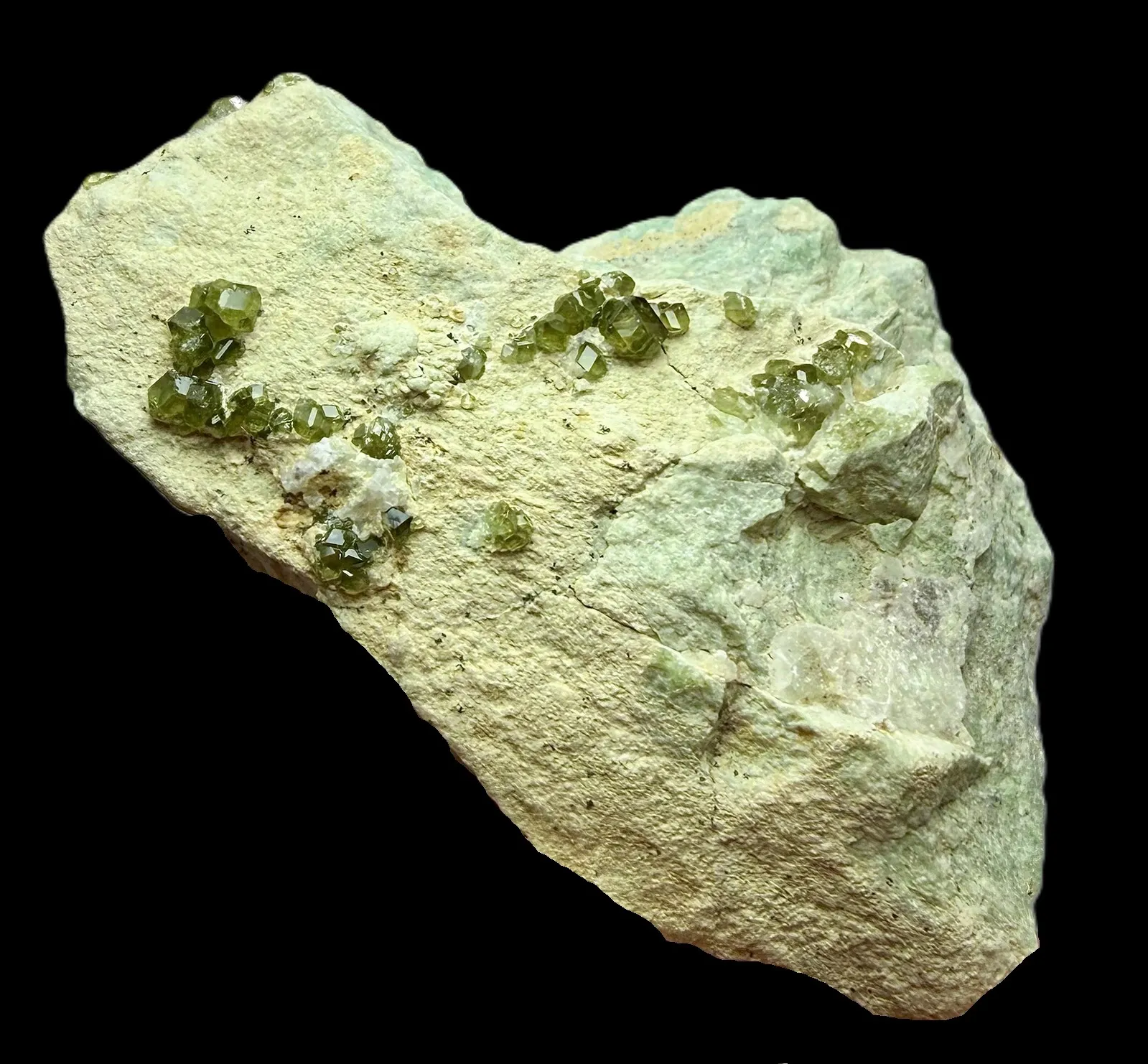
Demantoid Crystals in Serpentinized Host Rock
The material shown in the photographs and examined microscopically documents the formation of demantoid within a serpentinized ultramafic rock. The green garnet crystals represent a later hydrothermal mineralization that developed within the already altered host rock. Their formation can be understood as a sequence of serpentinization, fluid circulation, elemental mobilization, and subsequent garnet crystallization.
Ultramafic Protolith and Serpentinization
The original rock mass was rich in magnesium and iron and consisted predominantly of ultramafic silicates, particularly olivine and pyroxene. Such rocks commonly contain chromium-bearing spinels such as chromite and therefore represent an important source of the chromium that contributes to the characteristic green colour of demantoid.
Through interaction with aqueous fluids, the primary silicates became unstable during serpentinization and were progressively replaced by minerals of the serpentine group. Depending on the prevailing chemical and thermodynamic conditions, these may include antigorite, chrysotile, and lizardite. At the same time, hydration modifies the rock fabric and promotes the development of fractures, veins, and chemically reactive zones.
The greenish-grey matrix of the material examined here can therefore be interpreted as a strongly serpentinized ultramafic host rock.
Hydrothermal Alteration and Elemental Transport
The fluids circulating during and after serpentinization caused further chemical differentiation within the rock. Within fractures and reaction zones, elements could be mobilized from the host rock, transported over short distances, and subsequently precipitated under changing physicochemical conditions.
The formation of andradite required, in particular, calcium, iron, and silicon to be available in suitable concentrations and chemical forms. Andradite has the idealized composition Ca₃Fe₂(SiO₄)₃. The chromium responsible for the characteristic colour of demantoid is derived from the chromium-rich ultramafic protolith and could be mobilized during fluid–rock interaction and incorporated into the growing garnet.
This process established the chemical conditions within the serpentinized rock necessary for the formation of a new calcium- and iron-rich garnet phase.
Nucleation and Crystallization of Andradite
Once the fluid system reached sufficient supersaturation with respect to andradite, nucleation began. Initial microscopic crystal nuclei formed on suitable surfaces within fractures and cavities.
Subsequent crystal growth proceeded through the continuous incorporation of ions and structural building units from the fluid phase. Calcium occupies the large structural sites within the garnet lattice, while iron and part of the chromium occupy octahedrally coordinated sites. Silicon forms the SiO₄ groups that constitute the framework of the garnet structure.
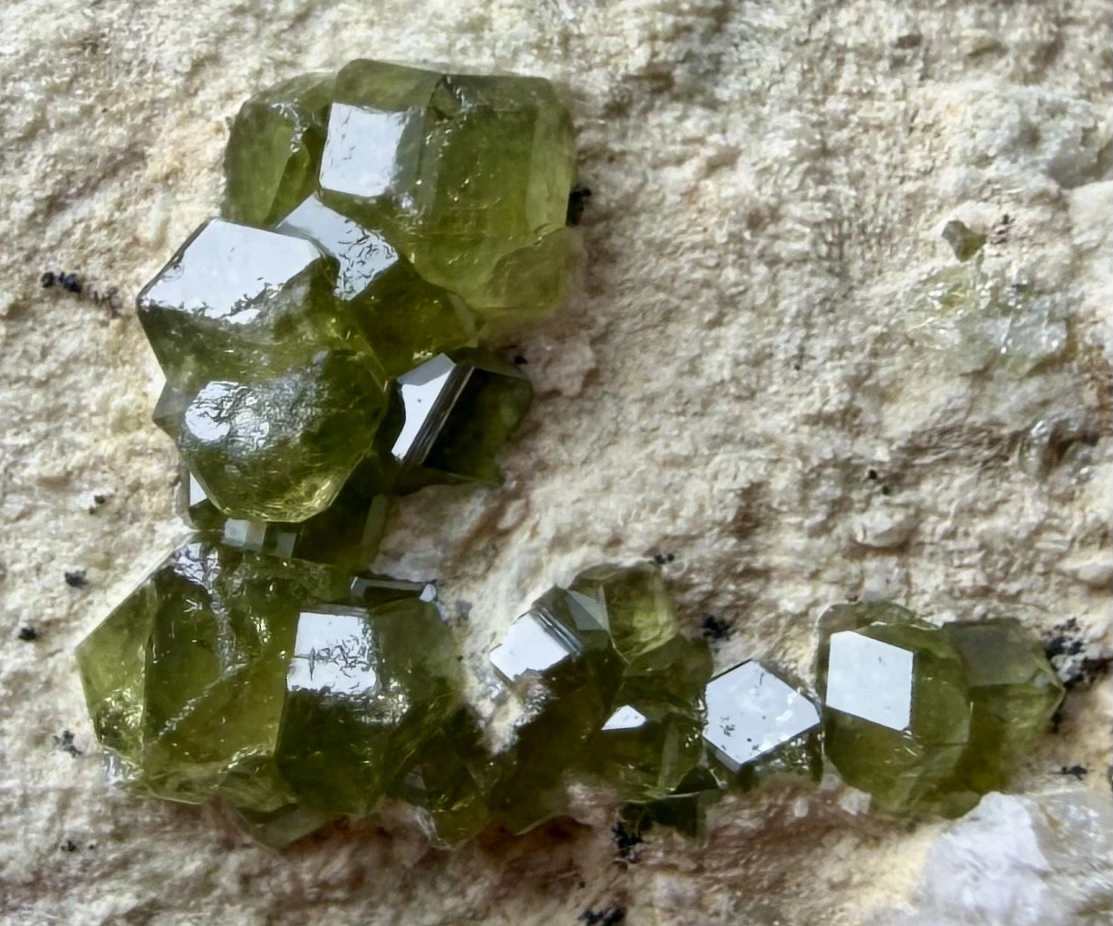
The incorporation of chromium produced the characteristic green demantoid variety of andradite. Colour intensity is influenced, among other factors, by the chromium content and its distribution within the crystal.
Crystal Growth within Fractures
The demantoid crystals visible in the photographs formed within cavities and fractures created by hydrothermal alteration of the matrix. These spaces provided sufficient room for the garnet crystals to develop their own crystal faces during growth.
The morphology of the crystals was controlled by the available space, growth rate, and composition of the fluids supplying the growing crystals. Open areas allowed the development of well-formed crystal faces, whereas spatial constraints resulted in intergrowths or incompletely developed crystal forms.
The spatial relationship between the demantoids and the serpentinized matrix therefore records a relative sequence of mineral formation: serpentinization and structural alteration of the host rock preceded the crystallization of the demantoid.
Mineralogical Significance of the Matrix
The matrix provides important information about the geochemical conditions associated with demantoid formation. Serpentine minerals such as antigorite and chrysotile document the extensive interaction of the original ultramafic rock with water. Chromite indicates the chromium-rich nature of the protolith, while magnetite may occur as a characteristic product of iron redistribution during serpentinization.
Other possible associated phases, including talc, chlorite, and carbonates, reflect continued modification of the fluid system and may represent different stages of hydrothermal alteration. Carbonates such as calcite, in particular, may precipitate within fractures during or after demantoid formation.
For the interpretation of the material shown here, the identity of individual associated minerals is therefore not the only relevant factor. Their textures, spatial relationships, and mutual growth relations can reveal the relative sequence of mineral formation and provide insight into changes in the composition of the hydrothermal fluids during mineralization.
Yellow Fluorescence of the Matrix
Specific areas of the matrix exhibit yellow fluorescence under 365 nm ultraviolet light, indicating the presence of a fluorescent mineral phase within the associated mineral assemblage. Given the geological setting and the possible presence of carbonate minerals, calcite is a plausible candidate.
In calcite, fluorescence is produced by trace concentrations of activating elements or luminescent centres within the crystal lattice. The resulting colour and intensity can therefore vary considerably, even within a single occurrence.
The observed UV response provides an additional mineralogical characteristic of the matrix. Definitive identification of the fluorescent phase, however, would require mineralogical analysis, for example by Raman spectroscopy.
Genetic Interpretation
The microscopically examined material can be interpreted as the product of a multistage, fluid-driven mineral-forming process. Beginning with an ultramafic protolith, hydration first resulted in serpentinization and the formation of the matrix visible today. The associated structural and chemical alteration created reaction zones and fractures through which subsequent hydrothermal fluids could circulate.
During a later stage, calcium, iron, and silicon became available under conditions favourable for garnet formation. Andradite then crystallized within the resulting cavities. Incorporation of chromium produced the green demantoid variety, and the crystals subsequently continued to grow within the available fracture space.
The matrix therefore represents the host rock, reaction medium, and geological record of the demantoid-forming process. Its mineralogy and texture document the preceding serpentinization and hydrothermal alteration, while the demantoid crystals record the subsequent stage of mineral crystallization.