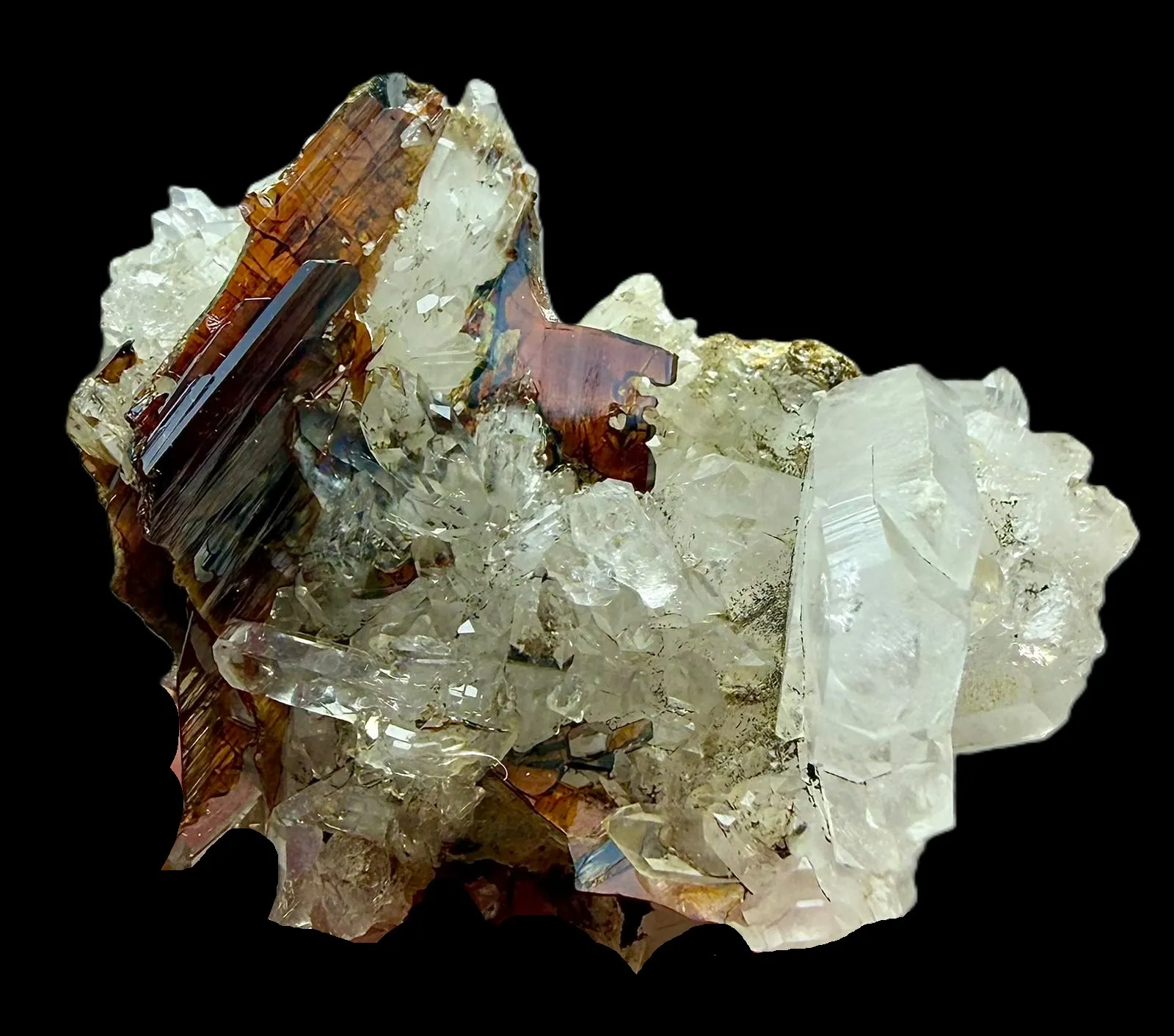
Brookite Crystals with Quartz Crystals on Matrix
Brookite is a polymorph of titanium dioxide (TiO₂) that forms under specific mineral-forming conditions. Its formation is closely linked to the mobilization of titanium, its transport by fluids, and the subsequent precipitation of TiO₂.
Mobilization and Transport of Titanium
Titanium is generally only weakly mobile under most near-surface conditions. For brookite to form, titanium must therefore first be released from a suitable source material and converted into a transportable form. This can occur during hydrothermal processes when hot, chemically active fluids interact with titanium-bearing minerals or rocks.
Titanium mobility depends strongly on fluid chemistry. Changes in temperature, pH, redox conditions, and solution composition can influence the chemical form of titanium and its ability to be transported. During fluid circulation, titanium may therefore be released from its original mineralogical environment and transported to areas where new mineral growth subsequently takes place.
Brookite Crystals on Quartz – Microscopic View
Supersaturation and Nucleation
When the solubility of the titanium-bearing species decreases or the chemical conditions of the fluid change, the solution may become supersaturated with respect to TiO₂. This favors the formation of a solid TiO₂ phase.
Crystallization begins with the formation of microscopic nuclei. Heterogeneous nucleation on pre-existing mineral surfaces, within microfractures, or at structural irregularities can be particularly favorable. Further TiO₂ can then accumulate around these nuclei, allowing a crystalline brookite structure to develop.
Formation of the Brookite Structure
Brookite, rutile, and anatase have the same chemical composition, TiO₂, but differ in their crystal structures. Which of these polymorphs forms is controlled by the conditions prevailing during mineral formation.
During brookite crystallization, Ti and O atoms arrange themselves according to the orthorhombic structure of brookite. The stability and growth of this structure are related to temperature, pressure, chemical environment, and crystallization kinetics. Brookite formation can therefore be understood as the result of a specific crystallization pathway within the TiO₂ system.
Crystal Growth
Following nucleation, additional TiO₂ components are transported from the fluid to the growing crystal surface. Because individual crystal faces have different growth rates, a characteristic crystal habit develops.
The morphology of brookite crystals is therefore not random. It is controlled by the crystal structure itself and by the rate at which material is incorporated into the different crystal faces. Changes in fluid composition or growth rate can consequently produce variations in crystal form and surface development.
In the material shown, the brookite crystals are developed on a pre-existing quartz surface. Such a surface can provide a favorable site for heterogeneous nucleation and subsequently serve as a substrate for continued crystal growth.
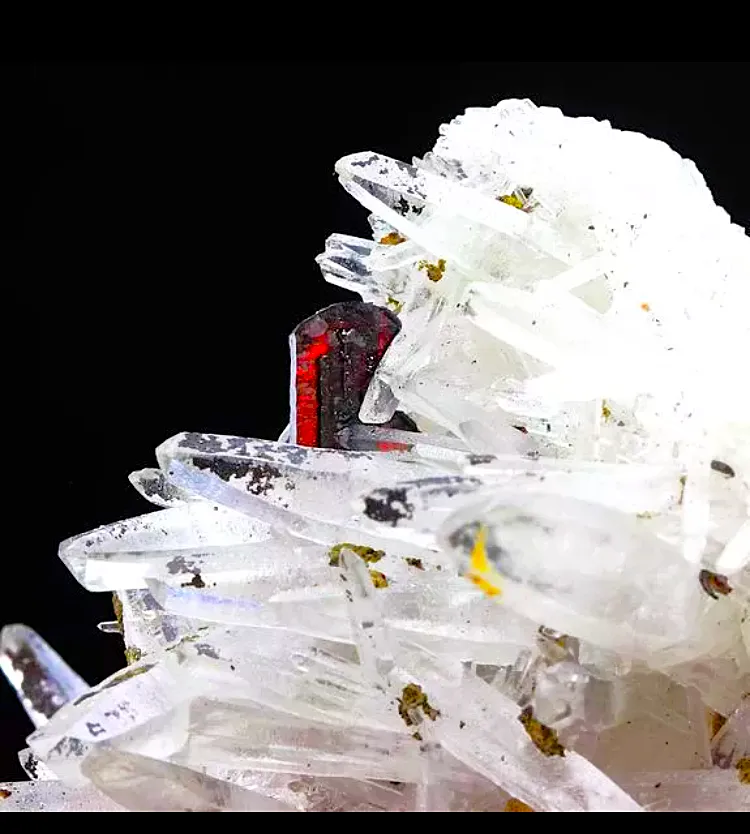
Aesthetic Brookite Crystal on Rock Crystal (Quartz)
Brookite within the TiO₂ Polymorph System
The three principal natural TiO₂ polymorphs, brookite, anatase, and rutile, have the same chemical composition but different structural arrangements. Their formation and possible transformation therefore reflect different thermodynamic and kinetic conditions.
Brookite can crystallize as a primary TiO₂ phase under suitable conditions. Changes in temperature or chemical environment, however, can alter the relative stability of the different polymorphs. The associated minerals and their spatial relationships can therefore provide important information about the conditions under which the brookite crystals formed.
Genetic Sequence
The formation of brookite can be described as a sequence of mobilization, transport, supersaturation, nucleation, and crystal growth. Titanium is first mobilized from its source material and transported by a fluid. A subsequent change in the physicochemical conditions causes supersaturation with respect to TiO₂. Initial nuclei then form on suitable surfaces, from which continued incorporation of TiO₂ produces the characteristic brookite crystals.